

Policing in the Second World War
1. On the Eve of War.
2. Policing the Home Front.
3. Women in the Police.
4. The Blitz in the West Midlands.
5. Police Officers in the Armed Forces
Introduction: While we have extensively covered the role of both men and women in policing the West Midlands during the Second World War, we must also investigate the police officers who chose to enlist in the Armed Forces, and fight away from the home front more directly against Germany and the Axis Powers.
This final section of this Learning Resource is dedicated to the war stories of two members of the Coventry City Police, and one member of the Birmingham City Police. One of these men served in the Royal Navy, one in the Royal Air Force, and one in the British Army, and all three gave their lives for their country during the war.
PC 37 James Crompton, Coventry City Police, Royal Navy
James was born in 1916, to Robert James and Frances Mabel Crompton, and he served in the Coventry City Police with the collar number 37. Although we know little about his career in the Police, we do know that he married Joyce Neville in Manchester, in 1941.
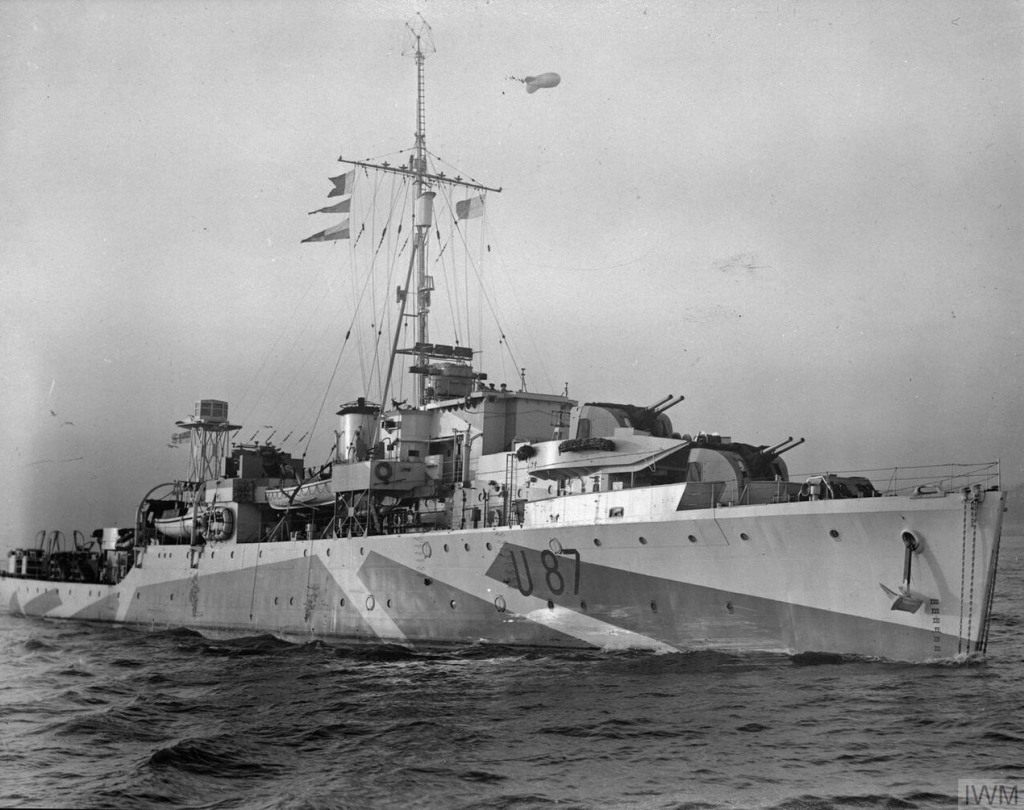
Photograph by the official Royal Navy photographer, from the collection of The Imperial War Museums.
James enlisted in the Royal Navy, eventually serving aboard H.M.S Kite, a Sloop-of-war commissioned in 1943 to protect convoys from German submarines, or ‘U-Boats’. These were used by the Germans to attack Allied shipping, such as convoys from Britain and America to send supplies and weapons to the Soviet Union in what was called ‘Lend-Lease’.
On the 22nd of May in 1943, H.M.S Kite departed from New York with other British Warships and James onboard to protect two convoys, ONS 8 and HX 240, both bound for Liverpool. On the 1st of June, shortly before the convoy arrived, H.M.S Kite was redirected to the Bay of Biscay near France to more aggressively attack the dangerous German U-boats. British ships at the time and in the region were subject to heavy air attacks, and on Friday the 4th of June, it is believed that James was killed in one of these attacks.
He was the only recorded death on this date, the same day as the convoy he had helped protect safely entered Liverpool. He was 27.
PC C197, Jack Watson, Birmingham City Police, Royal Air Force Volunteer Reserve
Jack was born in Hertfordshire in 1914, to Ernest James and Edith Geraldine Watson. Originally a metalworker, in 1936 he joined C Division of the Birmingham City Police with the collar number C197. He married Elizabeth Davies on Tuesday the 10th of June, 1941
On the 28th of July, Jack joined the Royal Air Force and became the pilot of a Halifax heavy bomber, one of the RAF’s heavy bombers used to attack industry, railways, and war plants in Germany. His fellow crew members were Radio Operator W.G. Brown, Flight Sergeant J.E. Lewis, Bombardier W.J. McKay (from the Royal Canadian Air Force), Engineer G.W. Rockwood, and Gunner J. Sutcliffe.
At 10.15pm on the 19th of June 1943, Jack and his crew took off in a 290 aircraft raid to attack an armaments factory at Le Creusot, in France. Despite originally being an ally of Britain, France was turned into a German Puppet (Vichy France) and later fully occupied and used to build weapons for Germany, and as such her factories were often bombed by the RAF. 181 of the aircraft in this raid were Halifaxes, and the two aircraft lost in the raid were of the type as well.
Jack’s crew failed to return from this raid, believed to have been shot down by German fighters or anti-aircraft guns. They have been buried alongside each other in the Brettville-sur-Laize Canadian War Cemetery near Caen. He was 29.
PC 171 George William Howlett, Coventry City Police, British Army
George was born in Ireland to Alfred and Eileen Howlett, and we know the least about his story, but the most about his family. He married Leonara Henrietta and served as a constable in Coventry prior to the war with the collar number 171.
George served in the 2nd Battalion of the King’s African Rifles, a decorated multicultural and multinational military unit that saw combat during the entire war. They fought against the Italians in East Africa, the German-aligned Vichy French in Madagascar, and against the Japanese in Burma during the often forgotten Arakan campaign.
Although we do not know how George died, he passed away on the 8th February in 1945 in Kenya. As his unit was active in Burma during this period, it is believed that he contracted a disease in the tropical climate, and was transferred to his unit’s home in British Kenya for medical attention.
George’s brother William and their father also served in the British Army, and William during the Second World War. William served in the Worcestershire Regiment and was killed defending Tobruk in North Africa on the 14th of June 1942, and is buried in a war cemetery in Libya. Their father, who passed away on the 16th of May 1940, had previously served in the Essex Regiment as a Drum Major. George’s age when he died is unrecorded, but his brother was 29.