
Published on | General
With over 200 years of history across the West Midlands it’s not surprising, but always delightful, when visitors add to our story with their own family tales. Recently we were visited by Roger, Katie, and Emily – relatives of Sergeant Percy Hartley whose career took him across the country to Liverpool, Tilbury, and Hull, before spending his final years in the force right here in the Lock-up.
Born in Northamptonshire in 1883, Percy began as a labourer in the iron works in Corby. Here he met his wife Alice, and as they started their family he looked for more reliable work, eventually applying to the Birmingham City Police. For the first year in the force he lived in station or recommended lodgings, leaving his wife and young son George behind.
“Actual training did not take up much of the recruits time, he learned in the finest school possible, the school of experience.” – George Hartley, son of Sgt. Percy Hartley
George related his father’s memories, a collection of incidents during his career, memorable characters, and a snapshot of life for a young officer in the early 1900s. His writings describe how between 1909 – 1911 labour unrest in the coalfields, railways, and docks, meant that Birmingham City Police were called upon to assist local forces.
“Dad was sent to Liverpool, Hull, and Tilbury docks… on one occasion he came home from Hull only to go away the very next morning to spend several weeks in a signal box.”
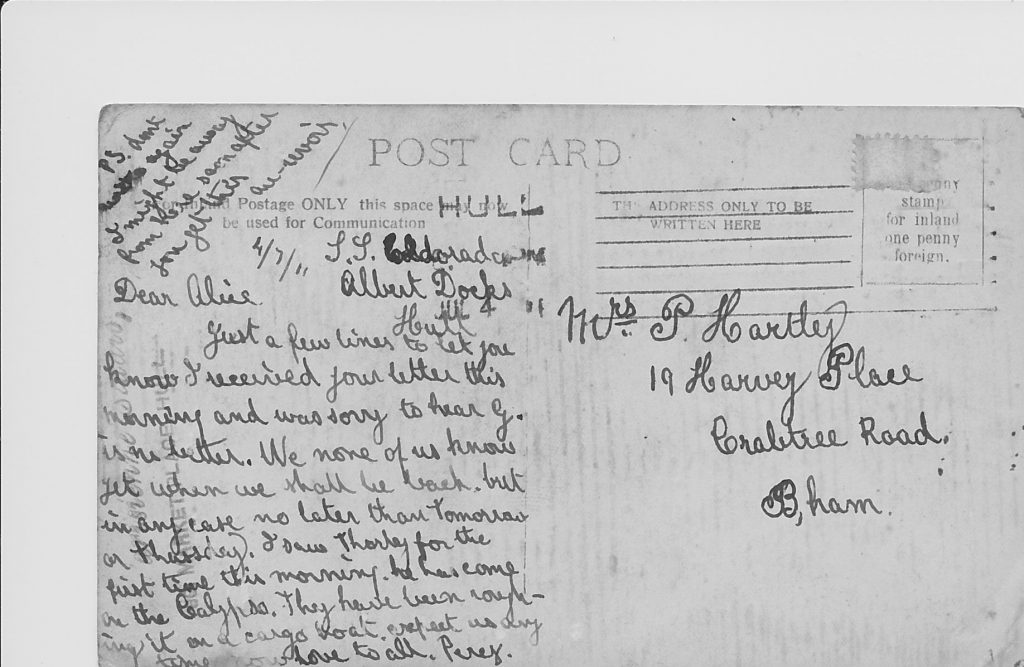
A postcard written by Hartley to his wife Alice whilst he was serving during the dock strike in Hull, 1911.
In 1911 Hartley was promoted to Sergeant, and the family moved further into the city to the ‘crescent’ off Cambridge Street. George recalls how it was a strict rule of the time that an officer must reside within their Division and the relief his father felt when he was transferred from ‘C’ Division to ‘A’ Division, having technically broken this rule by roughly 75 yards!
At over 6 foot tall and weighing just shy of 18 stone, Sgt. Hartley was quite literally a force to be reckoned with, becoming a recognisable figure on the streets of Birmingham, and well known for not shying away from a fight.
“He was a very impressive figure as he marched through streets, he never walked, always strode” recalled George.
During processions and parades it was common for Sgt. Hartley to be asked to lead the way due to his stature, made all the more imposing by the addition of his helmet adorned with a silver spike.
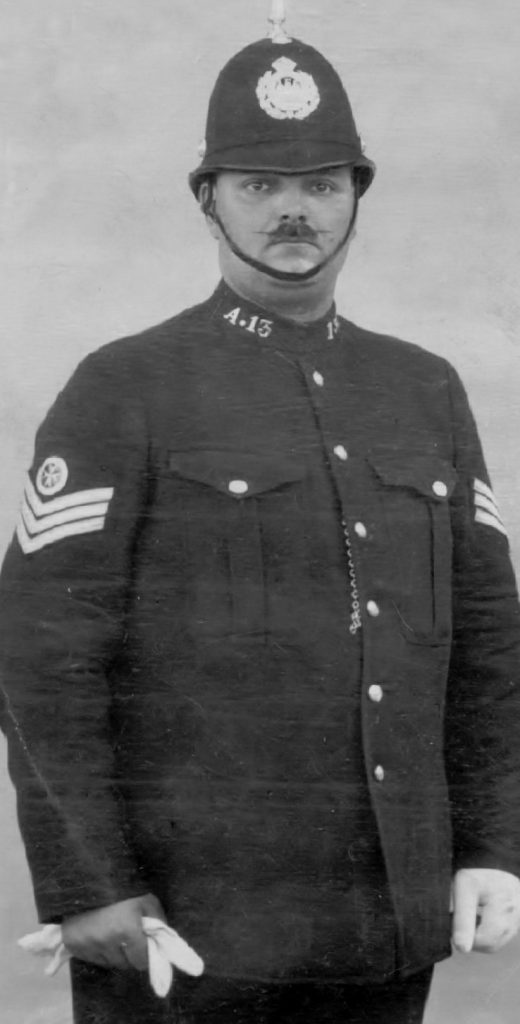
In 1926 deteriorating health led to Sgt. Hartley being transferred to the Lock-up on Steelhouse lane. “This job suited him” writes George, “he had been working outside in all weathers for over 20 years. I do not recall him having any other health problems for the rest of his working life.” During his time at the Lock-up, Sgt. Hartley dealt with some renowned criminals including Ridley and Betts, the murderers whose case redefined how an accessory to a crime were convicted, as Ridley had been the ‘getaway driver’ during the incident who faced the same sentence despite not directly committing the murder.
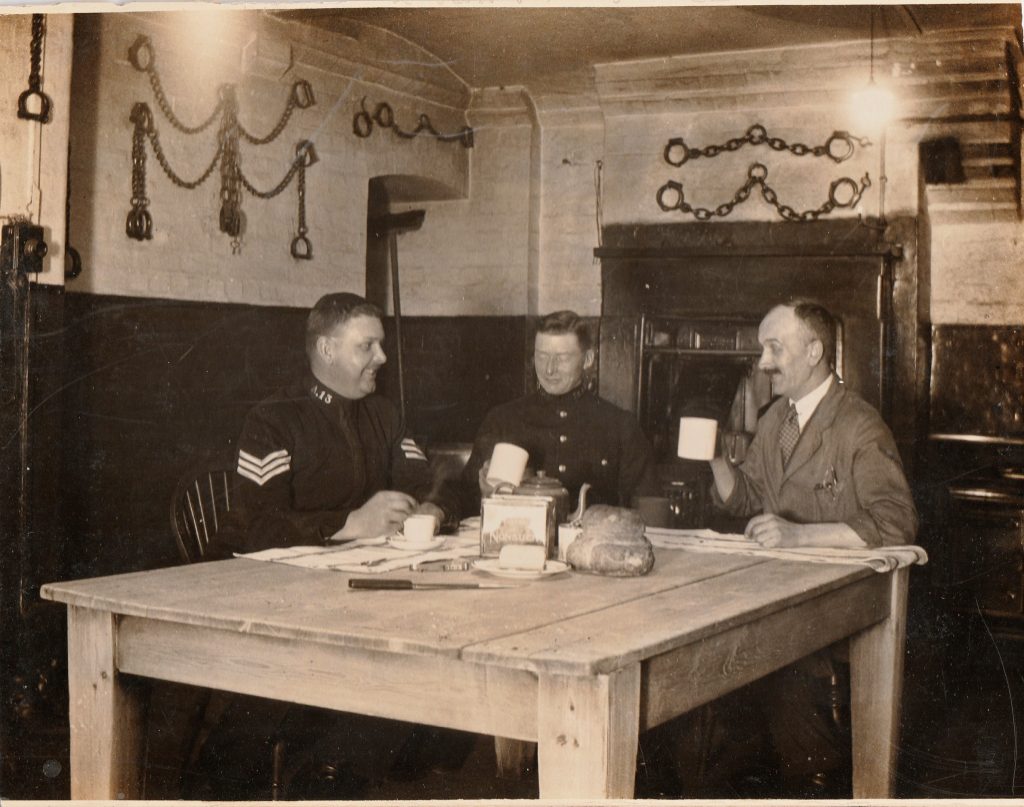
Photograph of officers and the force photographer sharing a cup of tea in the Lock-up kitchen circa 1928, featuring Sgt. Hartley on the left.
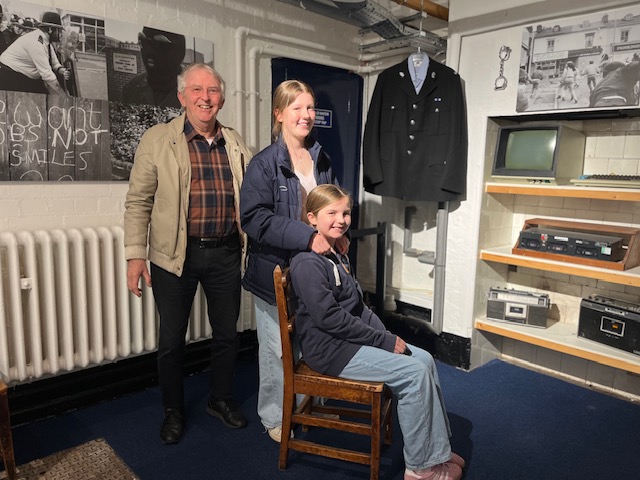
Descendants, Roger, Katie, and Emily at the West Midlands Police Museum, in the former Lock-up kitchen, 2026.
Roger is the grandson, and Katie and Emily are the great-great-grandchildren of Sgt. Hartley.
Sergeant Hartley retired in 1930, and was incredibly touched by the parting gifts from his colleagues including a Westminster chiming clock. He and his wife Alice moved to Worcestershire on the outskirts of Evesham where Hartley continued to serve the public by joining the local Parish Council, and the Urban District Council at Evesham.
Sergeant Percy Hartley passed away peacefully in 1936 – representatives of many public bodies attended an interment and the local papers paid tribute to the work he had accomplished throughout his life. He and his wife Alice had six children in total, George, Doris, Ethel, Herbert, Ernest, and Howard.
With thanks to John Hartley for sharing his father George’s family history and photos with the West Midlands Police Museum.